
Indian benchmark indices Sensex and Nifty rallied in early trade, driven by a significant decline in crude oil prices and positive developments on the geopolitical front, alongside strong performance in blue-chip IT stocks. Track Sensex, Nifty on July 2, 2026

India's leading passenger vehicle manufacturers are significantly increasing investments and factory capacities, alongside planning major product launches for FY27, driven by strong confidence in sustained domestic demand growth despite global geopolitical tensions and supply chain risks.

Tata Motors' 2026 Tiago facelift is a tech-loaded and safety-focused entry-level hatchback, with prices starting at Rs 4.69 lakh.
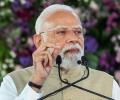
A day before US President Donald Trump's additional 25 per cent tariff kicks in, Prime Minister Narendra Modi on Tuesday made a vehement pitch for swadeshi and Make in India that should help create jobs in the country.
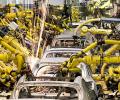
Passenger vehicle sales in India reached a record high of 4.7 million units in FY26, boosted by strong performances from major automakers and the implementation of GST 2.0.

Mahindra and Mahindra (M&M) recorded the sharpest acceleration among large players, with EV retail jumping to 33,513 units from 7,139 units, an almost 5-fold jump, aided by strong demand for new launches.


Fuel prices have risen by about Rs 7.5 per litre since May 15, as global crude oil prices surged due to the ongoing conflict in West Asia and supply concerns around the Strait of Hormuz.

Almost 30 per cent of Maruti's auto-component exports are to the US, and about half of that is facing a duty of 25 per cent and the other half 50 per cent.

The India-EU free trade deal could help Indian-made cars enter Europe at lower costs and challenge Chinese dominance.

Maruti Suzuki sold more cars than ever before, earned more money, and saw many first-time buyers choosing small cars again.

Maruti Suzuki India on Wednesday said its consolidated net profit increased by 16 per cent to Rs 3,727 crore for the third quarter ended December 31, 2024. The auto major had reported a net profit of Rs 3,207 crore in the October-December period of last fiscal.

Japan is expected to increase its investment target in India from the earlier 5 trillion yen ($34 billion) to almost 10 trillion yen.

A deep split has emerged within India's auto industry over the proposed CAFE exemption for small cars, with only Maruti Suzuki and Renault backing the move in the final SIAM vote.

Passenger vehicle sales in India kicked off on a flat note in new fiscal 2024-25 with 3.38 lakh units sold in April, impacted by high base effect and muted demand due to the ongoing general elections. Dispatches of passenger vehicles from manufacturers to dealers were at 338,341 units in April 2024 as compared to 332,468 units in the same month last year, a growth of 1.77 per cent with major players Maruti Suzuki India, Hyundai and Tata Motors reporting marginal growth in their domestic wholesales.

In 2025, the Maruti Suzuki Dzire has emerged as India's top-selling car, while sport utility vehicles continue to rule the broader passenger vehicle market, capturing almost 55 per cent of the segment.

The operating performance of the country's largest passenger carmakers, Maruti Suzuki India (MSIL) and Hyundai Motor India (HMIL), in the July-September quarter (Q2) of 2025-26 (FY26) outpaced brokerage expectations.

Leading automakers Maruti Suzuki, Tata Motors, Mahindra & Mahindra, and Hyundai Motor India posted higher sales in January riding on the growth momentum ushered in by the GST reforms in the festive period last year.

Maruti Suzuki India on Thursday said the locally manufactured Jimny five-door model has made its debut in the Japanese market. The SUV, which is exclusively manufactured at Maruti Suzuki's Gurugram-based plant, was unveiled in Japan on Thursday.

The country's largest carmaker Maruti Suzuki India is recalibrating production of its upcoming model e-Vitara due to the shortage of rare earth magnets, industry sources said. The auto major is looking to produce around 8,000 units of the model by September as against the earlier stated plan of rolling out over 26,000 units during the period.

Maruti Suzuki India on Tuesday reported an 18 per cent year-on-year dip in consolidated net profit at Rs 3,102 crore for the second quarter ended September hit by the withdrawal of indexation benefit and change in the tax rate on long term capital gains on debt mutual funds. The country's largest carmaker had posted a net profit of Rs 3,786 crore in the July-September quarter of last fiscal.

Maruti Suzuki India on Wednesday said it plans to invest over Rs 925 crore to expand its captive solar capacity to 319 MWp by FY2030-31. The car market leader announced the expansion of its solar capacity by 30MWp with two new projects.

The domestic car market leader said there will be no cash outflow from MSI as the merger is proposed to be effected through a share swap agreement.
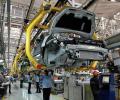
India's passenger vehicle (PV) industry is projected to experience moderated growth in FY27, following a strong rebound in H2FY26, primarily due to the high base effect, absorbed pent-up demand, and the lingering impact of geopolitical tensions in West Asia.

'In the January-August period, the share of hatchback in the overall PV industry sales was about 22.4 per cent. In the September-October period, the share of hatchbacks has come down to 20.4 per cent. In just October, their share was just 20 per cent. This is simple wholesale data from industry body SIAM.'

Speaking at the forum, Suzuki Motor Corporation (SMC) representative director and president Toshihiro Suzuki said, "Suzuki's future mission is to achieve carbon neutrality with small cars. "We will continue active investment in India to realise Self-reliant India (Atma-nirbhar Bharat)." Under the MoU, the company's wholly-owned arm Suzuki Motor Gujarat Pvt Ltd (SMG) will invest Rs 7,300 crore for the construction of a plant for BEV batteries at a land neighboring to SMG's existing plant by 2026.
The proposal was cleared by FIPB at its meeting on March 30, 2005.\n\n

Tata Motors Passenger Vehicles Ltd expects contribution of SUVs to its overall sales to go beyond 70 per cent with it making foray into the fast growing mid-sized segment with a premium positioning of its Sierra model, according to its Managing Director & CEO, Shailesh Chandra.

Maruti Suzuki's e-Vitara marks its high-stakes EV debut with strong export ambitions, lifting its stock even as analysts caution over pricing and fierce competition.

Speculation about rising competition from global majors has led to shares of major Indian automobile manufacturers such as Mahindra & Mahindra (M&M), Maruti Suzuki India, and Tata Motors taking a hit on the BSE.

Japanese agri-equipment firm Kubota is taking cues from Suzuki Motor's strategy to establish India as its global production hub, according to a report by Nikkei Asia. The acquisition of Escorts in 2022, leading to the rebranding as Escorts Kubota, a prominent tractor manufacturer in India, which held the fourth-largest global market share, offered Kubota a crucial foothold in the Indian and international markets, complementing its strengths with Escorts' established presence.
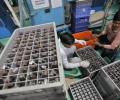
The automobile and auto-ancillary sector is expected to show strong Q3FY26 results, aided by festival-led demand, rationalisation in goods and services tax (GST) rates for select categories of vehicles, easing interest rates, and improving rural sentiment.

Japanese auto major Suzuki Motor Corporation (SMC) on Wednesday said its long-serving chairman Osamu Suzuki will retire and assume the role of senior advisor subject to shareholders' approval in the ordinary general meeting to be held in June this year.

Since the Indian government reduced GST on small cars on September 22, the small car segment's share in Maruti's overall sales has risen to more than 25 per cent, up from 16.6 per cent earlier in FY26.

'The reported deal between the European Union and China should mitigate it (shortage) for the medium to long term. Let's wait and watch how this plays out.'

With the demand of diesel cars very high in India, the company said it is also lining up more diesel engine cars for the country.

The stock of the country's largest passenger vehicle maker, Maruti Suzuki India (MSIL) was down 1.06 per cent in trade on margin pressures in Q1FY24, mixed market share outlook, and earnings impact due to the buyout of Suzuki Motor Gujarat. While MSIL has decided to terminate the contract manufacturing agreement and acquire Suzuki Motor Gujarat, the quantum of payment and mode (cash/equity swap) has not been decided. If the cash option is opted for, there would be a 3.5-4 per cent hit to MSIL's FY25 earnings per share as the deal is expected to be completed by the end of the current financial year.

With demand continuing to be strong post the festive season, leading automakers, Maruti Suzuki, Tata Motors and Mahindra & Mahindra, saw robust growth in sales in November as compared to the same month last year. Maruti Suzuki India reported the best-ever total sales, including exports, last month at 229,021 units, a year-on-year growth of 26 per cent as compared to November last year.

After a successful tie up in traditional ICE and strong hybrid models, Suzuki and Toyota are now set to take their partnership to the next level: the electric vehicle segment. Both the Japanese auto giants recently announced a plan to produce Suzuki eVX-based SUV which will be sold under Toyota brand across the globe. This electric SUV, bearing Toyota's logo, will go for production at Suzuki Motor Group (SMG) facility in Hansalpur, Gujarat beginning the spring of 2025, marking the first EV launch for both companies in India.
